
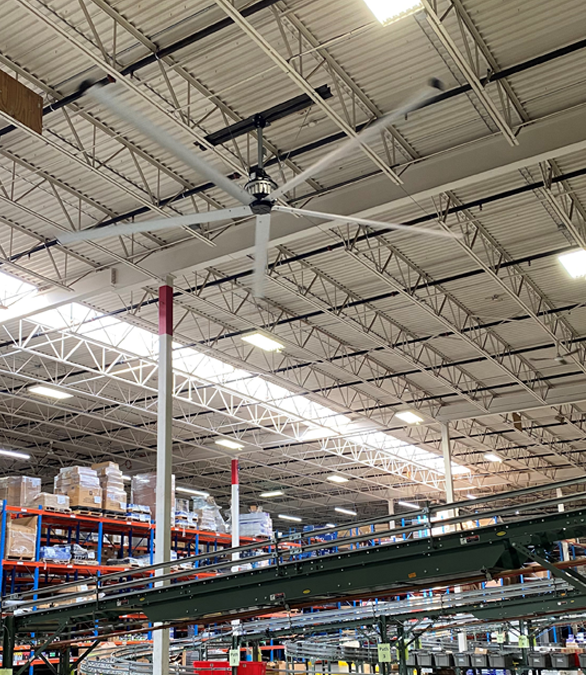
Heat is not a seasonal annoyance in a facility that is constantly working. Machinery that operates continuously generates heat, and without an effective plan to control it, the repercussions add up: equipment problems, worker fatigue, production slowdowns, and rising energy costs with each shift.
The Unique Heat Challenge of Continuous Production
Standard manufacturing facilities have an inherent benefit over 24/7 operations: downtime. If a facility is shut down overnight or during weekends, residual heat evaporates, equipment cools, and the building temperature returns to normal. With the subsequent shift, the temperature range is under control.
Continuous manufacturing facilities do not have such a reset. Heat from the first shift remains when the second shift starts. By the third shift, ambient temperatures within the facility can be 10–15°F higher than outside temperatures, and in warmer months or in facilities that handle high-heat items such as metals, plastics, or food products, the difference can be much larger. The structure efficiently serves as a heat storage medium, absorbing thermal energy more quickly than passive ventilation can dissipate it.
All this heat accumulation only exacerbates the problem. As workers get tired, they make more mistakes and are at increased risk of developing heat-related illness, resulting in greater production losses and, in severe cases, a higher risk of failing to meet regulations. Equipment in high-temperature environments experiences decreased performance, accelerated aging, and more frequent maintenance. A continuous heat load on an HVAC system consumes much more energy than a periodic one.
The solution is not merely greater cooling but more efficient airflow. Large continuous production facilities require HVLS fans.
Why HVLS Fans are Purpose-Built for Round-the-Clock Heat Management
High-Volume, Low-Speed fans are engineered to circulate high volumes of air at low speed and with little noise and energy usage. A single 20-foot HVLS fan at optimal speed circulates air over 20,000 to 25,000 square feet of floor space, requiring only about 1 kW (kilowatt) less than a typical domestic kettle. This efficiency profile is not just appealing in a 24/7 world; it’s game-changing.
Evaporative cooling is the primary mechanism. When air is moving, it rapidly removes moisture from the skin, lowering the perceived temperature by 4-8°F. For workers on a night shift in a facility that has been getting hotter for 16 hours, that perceived reduction is the difference between a manageable working environment and one that actively impairs performance.
HVLS fans also tackle the stratification issue that arises in tall, continuous-production buildings. Warm air rises and gathers at ceiling level. In a facility running three shifts, this ceiling-level heat mass accumulates throughout the day and never fully dissipates. HVLS fans continually mix the air column, dispersing accumulated warmth and preventing thermal gradients from reaching the working zone.
| 8,760
operating hours per year in a true 24/7 facility |
4–8°F
perceived cooling effect from continuous air movement |
30%
typical reduction in HVAC load with HVLS supplementation |
1 kW
approximate power draw of a 20-foot HVLS fan at full speed |
The Energy Cost Equation for Always-On Facilities
Energy usage in a 24/7 facility is measured differently than in a conventional 8- or 10-hour operation. Every inefficiency in your air management approach accounts for 8,760 hours per year, not 2,000 or 3,000. This dramatically raises the cost of doing nothing, making the ROI case for HVLS fans even stronger.
Consider a 100,000-square-foot continuous manufacturing facility currently using a combination of HVAC and high-speed pedestal fans to regulate heat. Working against a constant heat load around the clock, the HVAC system consumes energy at a rate 20–30% higher than it would in a building with effective air movement. At an industrial electricity rate of $0.10 per kWh and an annual HVAC energy consumption of 500,000 kWh, the inefficiency premium amounts to $10,000–$15,000 in avoidable energy spend.
HVLS fans reduce HVAC load by allowing thermostat setpoints to be raised by 4–6°F during warmer months and by eliminating thermal stratification that forces heating systems to overwork in cooler periods. The fans cost approximately $350 per unit per year to run at full speed around the clock, a fraction of the HVAC savings they generate.
KEY INSIGHT:
In a 24/7 facility, the payback period for HVLS fan installation is often shorter than in a conventional operation, not because the technology performs differently, but because it runs and saves energy for three times as many hours each year. In a continuous production setting, an investment that pays back in three years in a single-shift operation often pays back in less than two years.
Equipment Longevity and Maintenance: The Hidden Dividend
While energy savings are the obvious line item in an HVLS ROI calculation, in continuous production facilities, equipment longevity can be just as important, and in most cases, it’s much more difficult to calculate that ROI without maintenance records.
Machinery operating in high ambient temperatures will run hotter than intended. All motors, bearings, control systems, and electronic components have thermal operating limits and exceeding those limits increases the rate of wear and failure and reduces the service life. Even a small increase in equipment service life, such as an extra six months between major overhauls, means tens of thousands of dollars in deferred equipment capital expenditure in a facility that’s running around the clock.
HVLS fans moderate the ambient temperature around both equipment and workers. By maintaining a more consistent, lower ambient temperature throughout the facility, they reduce thermal stress on machinery and extend the intervals between maintenance interventions. Facilities that recorded maintenance costs before and after HVLS installation consistently reported lower unplanned downtime and a lower frequency of component replacements.
Shift Worker Comfort and Productivity: The Operational Case
Night-shift and rotating-shift workers are among the most thermally vulnerable groups in any industrial environment. Their circadian rhythms are already disrupted, their sleep quality is frequently compromised, and their physiological capacity to tolerate heat stress is lower than that of a daytime worker on a regular schedule. In a facility where temperatures have been rising for hours before the night shift begins, they walk into the day’s harshest thermal conditions.
The effects of heat stress on cognitive performance, reaction time, and error rates have been consistently demonstrated in occupational health studies involving additional heat exposure, particularly when workers are already fatigued from shift work. This isn’t a hypothetical worry in a continuous manufacturing operation where manpower monitors product quality and process consistency across all three shifts. It’s a direct operational risk.
The HVLS fans distribute air evenly across all shifts. Spot cooling solutions create comfortable zones for certain workers, whereas an appropriate HVLS installation provides the entire production floor with a uniform temperature and thermal environment, allowing the third shift to work safely and in the same thermal environment as the first shift.
Specification Considerations for 24/7 Environments
Continuous manufacturing facilities place specific demands on all air management equipment, including HVLS fans. Motor reliability and bearing longevity are the primary considerations. A fan that requires maintenance downtime in a facility designed to never stop is a liability, not an asset. High-quality HVLS fans are built with industrial-grade motors rated for continuous operation, and the best products carry warranties that reflect this design intent.
Noise is also a more significant consideration in 24/7 environments than in single-shift operations. Workers on overnight shifts in quieter production periods will notice fan noise that a daytime team in a loud manufacturing environment would never register. Specifying fans with low noise ratings and ensuring they are mounted and balanced correctly at installation eliminates this concern entirely.
Finally, control integration is important. A facility running 24 hours a day would require manual speed adjustment, which is impractical. Speed profiles can be programmed in advance for HVLS fans with programmable controls or integrated with a building management system, optimizing the fan’s operation across different shifts without requiring involvement from the manufacturer, who is already running a production process.
FAQs
- Are HVLS fans reliable enough for continuous 24/7 operation?
Yes. Quality HVLS fans are built with industrial-grade motors specifically rated for continuous operation. Leading products carry multi-year warranties covering parts and motor components, making them a dependable long-term solution for facilities that cannot afford unplanned downtime. - How do HVLS fans help with heat build-up across multiple shifts?
HVLS fans continuously circulate air throughout the full height of the facility, preventing warm air from accumulating at ceiling level between shifts. This keeps ambient floor-level temperatures consistently lower, even after hours of continuous machinery operation and sustained heat generation. - Will HVLS fans be too noisy for overnight shifts when the facility is quieter?
Not if specified correctly. Quality HVLS fans operate at very low noise levels, typically below 45 dB, well within comfortable working ranges. Correct mounting and commissioning eliminate vibration noise, ensuring fan operation is unobtrusive across all shifts, including overnight. - Can HVLS fans be integrated with our building management system?
Most modern HVLS fans support BMS integration and programmable controls. This allows speed profiles to be automatically scheduled across shifts and adjusted in response to temperature sensors, eliminating the need for manual intervention and ensuring consistent performance around the clock. - Does running HVLS fans continuously significantly increase our energy bill?
No. A 20-foot HVLS fan running continuously costs approximately $350–$400 per year in electricity. The HVAC load reductions and efficiency gains they generate consistently outweigh this operating cost, delivering a net energy saving even when running 8,760 hours annually. - How quickly can a 24/7 facility expect to see ROI from HVLS fan installation?
Typically, within 18–24 months. Because the fans run three times the annual hours of a single-shift operation, energy savings accumulate faster. When reduced maintenance costs and productivity gains are included, the effective payback period is often under 18 months.
Running a continuous production facility?
Refresh Fans provides free energy savings assessments tailored to 24/7 operations, ensuring your facility stays cool, efficient, and productive across every shift.